What to expect when you’re not expecting. A play on words but not on experience. Trying something new for the first time is a daunting idea, going through with it is a whole other beast. Here’s a break down of what to expect so you’re not sweating at the door and the minimal essentials to avoid the awkward panhandling for supplies.

“What on earth is Life Drawing?”
Surprise surprise, there are many types of art classes but we’ll focus on just one. You may have heard of the other well-known ‘Still Life Drawing’ which basically means you draw inanimate objects. The famous fruit bowl and vase. Oh yes – is the image getting clearer in your head? So Life or Live drawing means your subject shall be swapped out for fruits and replaced with the beautiful angles and curvature of a human body.
Nipples are likely Involved.
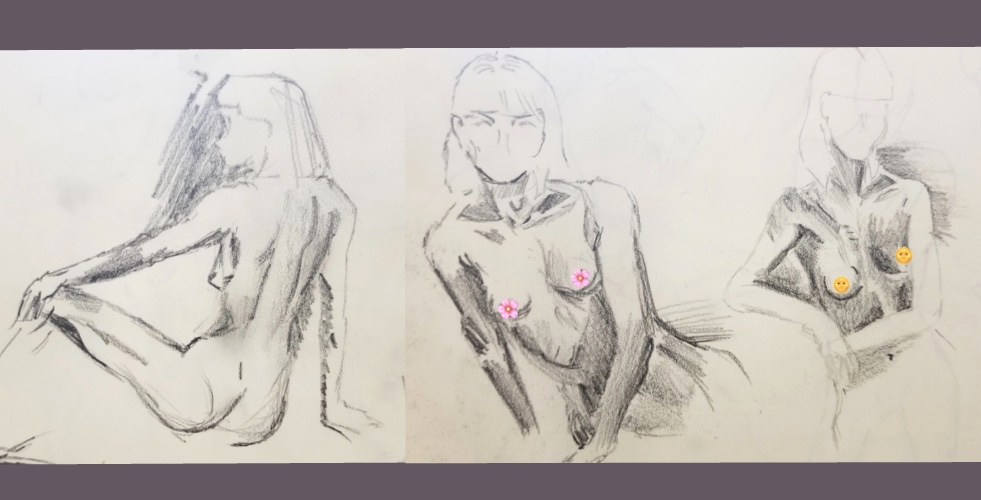
Art models or life/figure models are those rare and confident individuals who take painstaking care to give you the start you need to begin your work. They are completely (but not always) in the nude, though they can use props depending on the class. There may be one, there can be two.
They are naked so you can learn first hand what the human body looks and moves. If you want to learn how to draw people, this is the right place to be.
They stay statue-like, up to minutes on end, switching poses so you can observe precise shadows: the bones, the flesh, the softness and dynamic texture of skin and joints. Because of them there are countless things one discovers and learns when observing the body. They are truly the angels that help guide you on your drawing journey.
It’s a Race Against the Clock

The way classes are structured changes how you experience time
Don’t feel deterred when you check the class details and it reads 2 hours. The way classes are structured changes how you experience time and dispels the initially alarming duration.
Classes are broken down by a timer. You start with exhilarating 30 second rapid-fire rounds which are races of speed, precision, paper and pen(cil). Ever wonder how fast you can dart your head up and down to figure out what it is you’re even drawing? Neither did I.
It’s light-hearted, fun and dispels any stress you walk in with. And when you notice you didn’t get much done, you’re primed, ready and excited for the longer rounds. You move on to 1-3-5, 10-12-15 minute rounds. Next thing you know, class is over!
And don’t worry: water and bathroom breaks are in the plenty
A new discovery in technique late into class, a favourite body part you want to practice over and over again. It never really feels like you were quite done. Which is why you’ll find yourself signing up for the next one.
The Basics To Bring*
- Paper – you can get paper that best fits the art you practice, but any paper gets the job done – you’re practicing, not creating a masterpiece (unless you are).
- Pencils – and more, shading crayons, charcoals, artists markers, pens, it’s what YOU want to practice with
- Eraser + Sharpener
- A Flat, hard surface + tape or clips to keep loose paper in place
- Water/ a light snack – keep your brain sharp and active
** This is a list of basic essentials and helpful extras. For example, you don’t need a flat hard surface if you have a hardcover drawing book, you don’t need an eraser if you’re working with marker, bringing water or a light snack? Totally your discretion. But if it’s a painting class, it may be wise to bring paints.
If in Doubt, CALL📞💻📬
Galleries and studios hosting these events want you to feel comfortable and welcome. What time does it start? Need to confirm the location? Will isles be provided? Call in advance with any questions you have, no matter how trivial or silly they may feel. Why? Because Art is a personal experience and the goal is to feel comfortable and enjoy spending time doing it and that is true for all skill levels.
A prepared artist, is a happy artist.
Any form of contact works, but calling is always faster and more reliable.
 Arts . Culture . Ideas